
It’s a mess, but we get it done
Sure, it’s easy when it’s small. If you grow the party or increase the time, there is a lot going on and it’s not easy to align everyone. In fact, it’s often frustrating for all parties. But like I said, we get it done.
Communication paths are not centralized. Let’s adds a Group Chat for every event. It’s baked in.
There isn’t a good system, but the answer is basic: suggestions and polling.
Two dimensions: time and place
For a single event, it boils down to a decision in two dimensions: time and place. That’s what it takes to meet up, the minimum requirements. That and sharing that information clearly with all members.

Thanksgiving reflection
The first time I reflected on the planning process was after coming back to the Chicago area over Thanksgiving in 2016 and 4 of us were meeting up: two individuals and a couple. The couple had one person coordinating, so it was three people coordinating. For three people, we had an email thread 30 emails long to agree on a time and place.
For three people, we had an email thread 30 emails long to agree on a time and place.
Upon review, I wondered what features of a system would enable this process to be smoother and faster, to let me see more at once so I don’t have to scroll back to review previous information, something to guide us instead of plain text.
I came up with several features
- Time Suggestions
- Place Suggestions
- Voting on Suggestions (positive votes and negative votes)
- Group chat
- Comments on Suggestions
- For Times, suggest days, then select times.
- Set availability and unavailability
While this list of features covered that use-case and many other cases, it’s quite a list, and “Ideas are cheap. Execution is expensive.”
We decided to proceed incrementally with a system of a few of those features: time suggestions, place suggestions, voting (positive and negative), and a group chat. Regarding execution, we still have yet to implement and integrate those remaining three features, but we are getting there.
Today’s Tools
I’ve asked hundreds of people: what tools do you use to plan events? To plan events, people predominantly use group chats and calendar events. I, too, use those tools. So I was in a good position to reflect on them.
To plan events, people predominantly use group chats and calendar events.
Group chats can be fun, but when you are trying to coordinate, they can be frustratingly inefficient. While there is fun chatter, it can be distracting and make it hard to sort through information when you need it. The serialized format also seems silly: asking if a time is okay and reading the replies of “yes”, “yes”, “yes”, “no” (better hope no one messages in between), is inefficient — and there are many notifications.
Overall, the discussion offers flexibility, but it’s inefficient. Another quiet benefit of a group chat is you know where it is — right there in your messages. (But good like finding the info when you need it.)
Calendar events (Outlook, Google, Facebook or similar) are the opposite of Group Chats: efficient, but with no discussion. An executive decision with the choice of “In” or “Out” gets you a fast and clear answer. However, there is no room for discussion or suggestions. Calendar events do have the handy feature of being in your calendar with timely notifications (that you can set: if you want a day’s notice, add that notification).
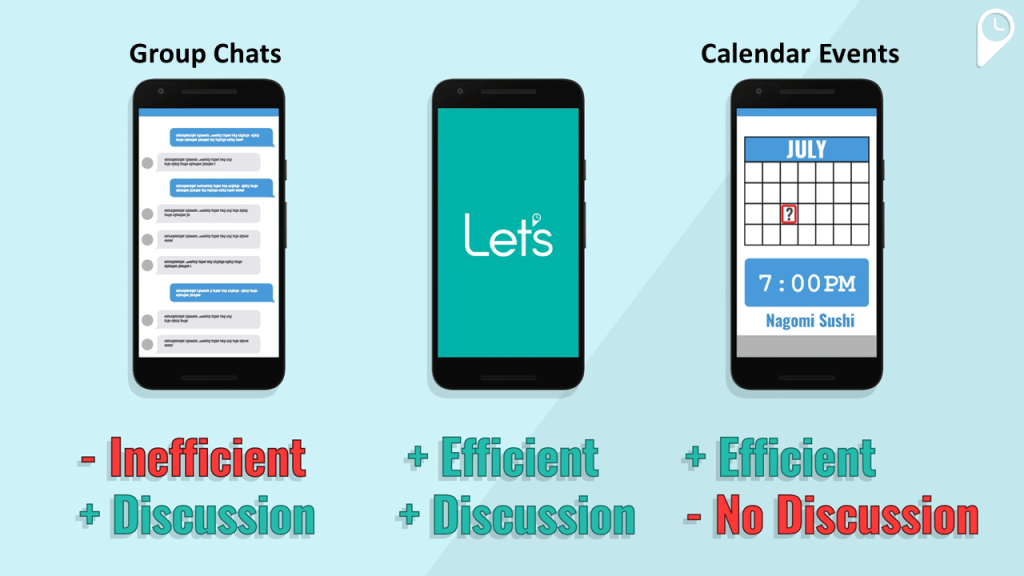
When positioning Let’s, our goal was to capture the efficiency of a calendar event with the flexibility of a group chat.
As a final note on tools, this is not the whole story: many diligent planners use documents and spreadsheets to make trade-offs and track polling.
Consensus is ideal
Ideally, to bring people together, you want consensus, that is, everyone agreeing on a time and place. If everyone agrees, it’s easy peasy. But how often does everyone agree on the first suggestion? There’s often a time conflict or multiple place options. Our system of suggestions and votes approximately captures this situation.
If not consensus, then make an informed decision
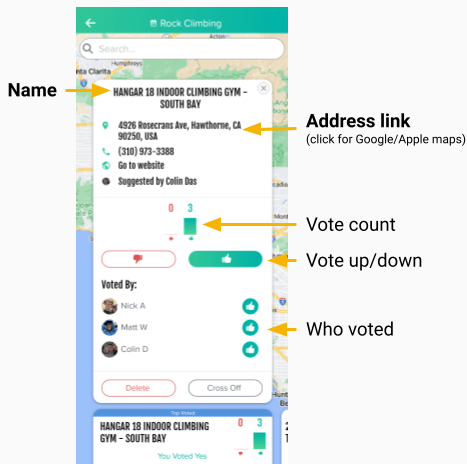
In practice, when there are many people involved, consensus is impossible. That is, some people have constraints that you simply must accept — and some of those constraints pose a hard conflict. You often accept a majority vote or you maximize those you consider a ‘must’. In this case, it helps to make an informed decision: how many people voted for what and who voted for what. Our UI gives you this visibility.
More than two dimensions
We say it’s two dimensions: time and place, but that is a bare minimum. In reality, you are often trading off more dimensions. Let’s look at some examples.
- In picking a restaurant, you want to check that a place has options to cover each person’s diet. You want to check that people are okay with the cuisine. You want to check that people are okay with the price / fanciness level. And, of course, it has to be available to seat your party at your time.
- In selecting a cabin for a recent trip, we traded off cost, amenities, accommodations, and views and we checked if it was pet friendly. The tricky element of cost was the more people who came, lowered the cost.
These added dimensions add complexity. Our minds are quite good at managing this complexity, but communicating it, polling it, and achieving consensus in a high dimensional space is not so easy. Our goal in Let’s is to ease this pain and reduce this complexity by visualizing it.
Clear information
If we’re going somewhere, send me a maps link
You know what I say: for a time, send a calendar invite and for a place, send me a maps link. If it’s on my calendar I can see it.
With a maps link, one click and I see it on a map, one more click and I can navigate there. If we’re going somewhere, I want a maps link first and foremost; I don’t want a name, an address, a screenshot — those require extra steps (remembering something or copying, switching apps, and pasting — better hope you don’t get interrupted). What I really want is all three: name, address, and maps link — which Let’s gives you.
Beyond Events: Trips
Planning a trip is a level beyond an event as it comprises of many events and some macro decisions and alignment.
In the blue sky planning phase, you must find date ranges that work for everyone or at least have some overlap. You must agree on locations to visit and modes of transportation.
The epitome of a difficult trip to plan was a climbing trip I went on in 2017 to Moab with an experienced crew of climbers. We had people coming and going at different times, we shared cars, we shared tents, and we had to manage food. We also had different climbing abilities and a wild amount of climbing gear, so the people and gear had to be split because easier and harder climbs were in different locations. We did it, but it was a mess — and I’m committed to creating a better way to manage communication and resources during trips.
After planning is execution
Planning is one element. Execution is another.
- Whose car are we taking? Can we carpool? It depends, where are you going after this.
- Are you there? Exactly where are we meeting? Which table are you at?
For now, we have a group chat with every event. This is a subtle, but invaluable convenience. In a group SMS, when you add a new person, it generates a new chat. This is annoying and the new person loses the chat history. In Let’s this is quietly handled, like adding someone to a Slack channel.
Our direction is to move decision-making elements from the chat to the decision-making system. In that vein, we added General Polls, not limited to time or place. We’ve used those when virtually meeting to do workout videos, we voted on which video to do. We also added checklists which have been used for potlucks and camping supplies.
Still, there is much that can be improved to simplify the process and offload mental burden and chat.
Conclusion and moving forward
While group event planning is a problem, we get it done. Our goal is to make it easier, to reduce the steps involved for everyone while also trying to include everyone’s opinion, allowing everyone to be heard. We do this by creating a system — one with suggestions and voting — where information is constrained to be clear: with maps links for places and time zones automatically handled. And much more!
Single events are still a challenge with many dimensions: who is going in what car, exactly where are we meeting, dietary preferences, etc. After events, we’ll move onto trips, which is my ultimate goal.
I consider Let’s still in its MVP stage. And no matter the product, getting people to sign up and switch is tricky. As it grows in value, so does our user base. We hope you give it a shot and enjoy it. And we are open to your feedback.
Start using the app here!
 Let's Blog
Leave a comment