
Note from the author
Background & Relevance
Julian wrote a fun and insightful article: multi-layered calendars.
The article approaches calendars with an open mind, proposing extensions to its functionality that better capture reality and serve its users.
Let’s is a service for group event planning that my team is working on. We take a similar open-minded approach and also try to create a system that better captures reality and serves its users — for group event planning.
About Let’s
Let’s breaks down group event planning to events, groups, and trips.
- Events are a single time and place. Even this can be difficult to coordinate with a group of people: aligning everyone’s schedules and preferences to get agreement on time and place — and then communicating it all.
- Groups are recurring events with a common group of people. The complexity here is when instances of the event must be changed. Then you are in the case of an event, trying to gain agreement on time. and place.
- Trips are the holy grail of group planning — finding available date ranges, suggesting activities, managing resources, creating schedules, making tickets and reservations, and executing it all.
Let’s approaches planning from a collaborative perspective with suggestions, votes, and messages. This applies in multiple dimensions, commonly time and place.
For both dimensions, suggestions reduce to a list view, which is where we started.

We have found that other views can provide more information to make decisions. For places, we have map views, so you can see relative locations on a map. (This is handy when weighing multiple place suggestions.)

For times, we will be adding calendar views — hence the direct relevance to the article. I wrote my responses below.
Formatting
Topic summary
- [Julian] “Excerpt / highlight from original article“
- [Colin] My comment. I’m Colin 🙂
Review
Calendars help us optimize time
- [Julian] “Time devices like calendars help us to plan and optimize how we spend our time.“
- [Colin] I like this abstract approach. Time devices like calendars are just one of many tools we use to plan.
Little technological focus –> Let’s agrees
- [Julian] “You would expect technologists and entrepreneurs to be intensely focused on perfecting such a magical time travel device, but surprisingly, that has not been the case.”
- [Colin] Overall, I agree! The planning process has not changed much. We think our current tools (calendars, chats, and spreadsheets) are mediocre for group planning — we get it done, but it’s a pain. Let’s aims to change the group planning process.
- [Colin] Also, let’s credit the efforts of many calendar-like services: cal.com, Fantastical, TidyCal, Calendly, SavvyCal, PlanHarmony, Doodle, and many more.
- [Colin] A fun news update. A related product called IRL came along and got $170M in Series C funding with a $1.2B valuation. We took it as good news that the market of event planning was real. However, we recently learned that [IRL] raised $200M from SoftBank and others is shutting down because 95% of its users were fake. This reduces support that a market exists for group event planning, but we strongly believe it does as personal interviews continue to validate the need.
Most digital calendars are similar to static, physical calendars
- [Julian] “Our digital calendars turned out to be just marginally better than their pen and paper predecessors. And since their release, neither Outlook nor Google Calendar have really changed in any meaningful way.”
- [Colin] A pretty harsh critique on digital calendars. High level, I agree — that digital and physical calendars look similar.
- [Colin] I think this is okay and even good because there is a familiarity (month view). Applying UX Law 6: Jakob’s Law, means that digital solutions should resemble their physical predecessors. However, the magic is that digital solutions can have multiple views and other interactive elements.
- [Colin] While they mostly look the same and have little functionality changes, digital calendars have added some critical improvements:
- time zones — automatically handled when traveling
- views (3 day, week, month) — like zooming in/out
- attachments — centralizes tickets and reservations
- syncing across devices — we expect it, but it’s critical
- calendar sharing — much potential, but under-utilized
- [Colin] Calendar sharing is rarely used — and it has so much potential. You can plan better with visibility into someone’s calendar — instead of asking them. This is why it’s easier to schedule meetings at work, than at home. (Though at large companies I’ve worked at, I had permissions issues and had to request access and sometimes didn’t get it.) Personal calendar sharing is lacking. SavvyCal, TidyCal, and Calendly are on the right track, but (1) require manual overhead in setting up availability (2) are mainly for 1-on-1 arrangements (3) don’t have much negotiation for location. So, we think Let’s has value-add here in group scheduling.
Concept: heavy overlap of notes, email, and tasks.
- [Julian] “The fact that we use four distinct tools suggests that note-taking, email, task management, and time management are four distinct activities. But when you look closer, you’ll realize that these activities are actually not that clear-cut. In fact, they all heavily overlap. Notes are just emails to your future self. Emails are just tasks.”
- [Colin] I love this and many people on the Twitter thread agree. I realized the same thing (over and over) when taking notes, which generate tasks, and those tasks would be emailed out.
- [Colin] My colleague would say “[you can assign work, but] if you don’t schedule it, it won’t happen.”
- [Colin] While in concept, notes -> tasks <-> emails, in practice, with existing project management tools, this is not so simple. That is, I have projects and projects have features, multiple features have dependencies, features have versions. So, generating tasks that integrate with existing project management systems (Azure DevOps, Jira, etc.) may not be that straightforward.
- [Colin] Still, the concept of notes/emails -> tasks and queuing them to be scheduled — is a dream. Then, we could distribute tasks onto calendars. Managers often want predictions on completion times. This process would facilitate that.
Concept: tasks are a calendar layer

- [Colin] I really like the concept of capturing surrounding (dependent and resultant) tasks and their associated times. The example of travel time is great. Currently, it’s either in your head or you manually block it out. If the meeting moves, you have to manually move those blocks yourself! Sure Google Calendar tries to notify you “you should leave for X meeting” but it’s not blocked off on your calendar, so people think you’re available when you’re not. Again, great point here.
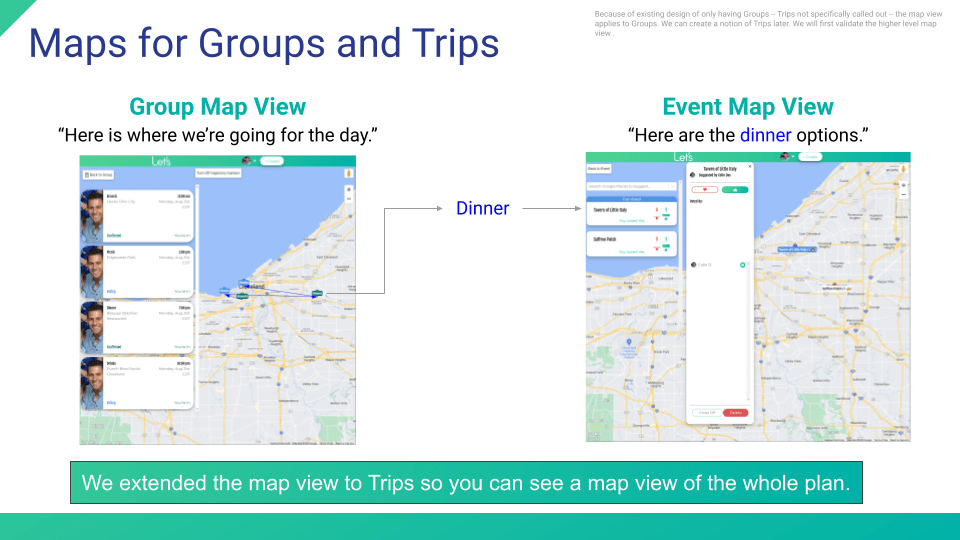
- [Colin] For Let’s trips, we hope to add modes of transportation which can help you plan better. It’s one thing to say I want to do these 4 activities today, but if they are each 2 hours apart and each take 2 hours, it may not be feasible. Calendars don’t help us with these critical logistical details, setting us up for failure. In Let’s, our first cut at this was to show a map view with straight lines of the events for the day. (Ideally, we’d add mode of transport and compute and render travel time, but it was easier to start with straight lines. Also, because events can have multiple place suggestions, for the Trip view, we select the confirmed or top-voted suggestion.) Pretty slick, huh?
Missing layer: Activities
- [Julian] “Flights, for example, should be native calendar objects with their own unique attributes to highlight key moments such as boarding times or possible delays.”
- [Colin] Cool concept. I’m on board. I want Let’s to eventually handle activity types.
Concept: integrations, eg, music, stress, sleep
- [Colin] Julian discusses a concept of a music calendar layer that shows what you were listening to at any time.
- “Most of these data layers are pretty meaningless in isolation; it’s only when we view them alongside each other that they unlock their value.”
- [Colin] Bingo. It’s difficult to see the value of each layer alone, but it’s easier to see the value together. Here’s my support: like everyone, I discover new songs and I listen to familiar songs over and over in life — and they remind me of where I was when I listened to them and who I listened to them with.
- [Colin] It would be fun to pick a song and see when I listened to it, on what trips, where I was, and who else was there. Integrating these layers would enable that. I could view it in my music library, maps, photos, calendar, or contacts.
- [Colin] Overall, I love where your head is at here. And others do too.
Closing statement
- [Julian] “These changes would not just make the calendar a stronger center of gravity in the aforementioned productivity stack, but turn into an actual tool for thought, where time serves as the scaffolding for our future plans and our memory palaces of the past.”
- [Colin] Beautiful — calendars as a tool for thought. Let’s make it happen. Let’s 🙂
Thank you, Julian, for writing this insightful article.
 Let's Blog
Leave a comment